
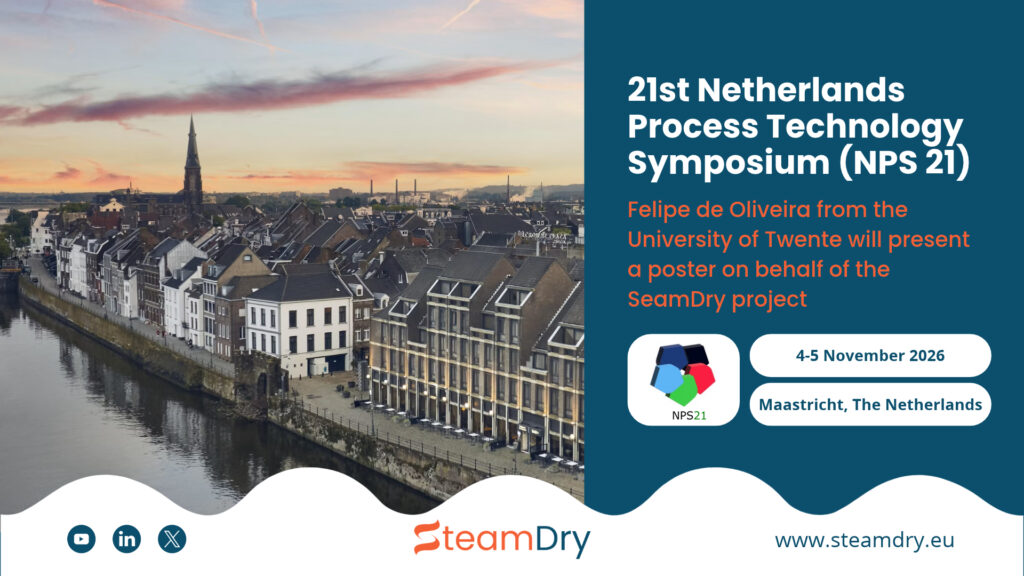
SteamDry will participate in the 21st Netherlands Process Technology Symposium (NPS 21), taking place on 4–5 November 2026 in Maastricht, the Netherlands. The project will be represented through a poster presentation by Felipe de Oliveira of the University of Twente, showcasing new research on filtration performance, operational flexibility and long-term optimisation in superheated-steam paper drying systems.
Hosted by Maastricht University, NPS 21 brings together researchers, industry representatives and other stakeholders working in process technology and chemical engineering. This year’s theme, “Chemical Engineering for a Sustainable Tomorrow,” focuses on the processes and technologies needed to enable greener manufacturing across sectors.
SteamDry poster presentation
Title: Operational Flexibility and Uncertainty in Long-Term Filtration–Cleaning Optimization for Paper Dust Removal from Superheated Steam.
Presenter: Felipe de Oliveira, University of Twente.
Co-authors: Mark de Wolff and Edwin Zondervan, University of Twente; Marcel Meinders, Wageningen University & Research.
The poster presents research addressing a key challenge for the scale-up of superheated steam drying (SSD): maintaining efficient operation when steam becomes contaminated by dust released during paper production.
Paper drying is one of the most energy-intensive stages of papermaking, accounting for around 70% of the process energy demand. SSD is a promising alternative to conventional air drying, with the potential to substantially reduce energy demand and associated CO₂ emissions. For this potential to be realised in an industrial closed-loop process, however, dust-contaminated steam must be effectively filtered and the filtration system must remain economically robust under changing operating conditions.
From filtration modelling to robust operation
The work presented at NPS 21 builds on previous SteamDry research combining a hybrid filtration model with a filter-cleaning model. It investigates how uncertainty in process and economic parameters affects the optimal operation of a filtration system over a 15-year horizon.
The analysis evaluates:
- The near-optimal region for cleaning-pressure thresholds and filter-replacement policies.
- The influence of changes in steam flow, temperature, dust loading, energy price, cleaning efficiency and cake density.
- The long-term economic implications of variable operating conditions, using Monte Carlo simulations.
- The key parameters that should guide future design and operational decisions.
Results indicate that a relatively broad range of cleaning and replacement policies can operate within 1% of the minimum cost. At the same time, the research identifies steam flow as the main driver of operating cost when the filter area is fixed. The simulated 15-year operating expenditure has a mean value of €2.337 million, while a budget set 5% above the median cost would cover approximately 80% of the evaluated scenarios.
These findings provide valuable evidence for designing filtration systems that are not only energy efficient, but also resilient to realistic operational variability. Future work will develop a dynamic, cycle-resolved model that can track filter condition over time and support state-aware re-optimisation under changing process conditions.
About NPS 21
The Netherlands Process Technology Symposium is a long-standing national platform for the exchange of scientific and industrial advances in process technology and chemical engineering. Its 21st edition will include plenary and keynote lectures, oral presentations and poster sessions across six thematic areas:
- Reaction Engineering & Catalysis
- Separation Processes & Transport Phenomena
- Process Systems Engineering
- Renewable Carbon Conversion
- Recycling Technologies
- (Bio)chemical Process Engineering
NPS 21 will be held at the Crowne Plaza Hotel Maastricht. The conference gala dinner and evening programme will take place at Rebelle Maastricht on 4 November.