Steamdry

Industrial heat is moving up Europe’s decarbonisation agenda

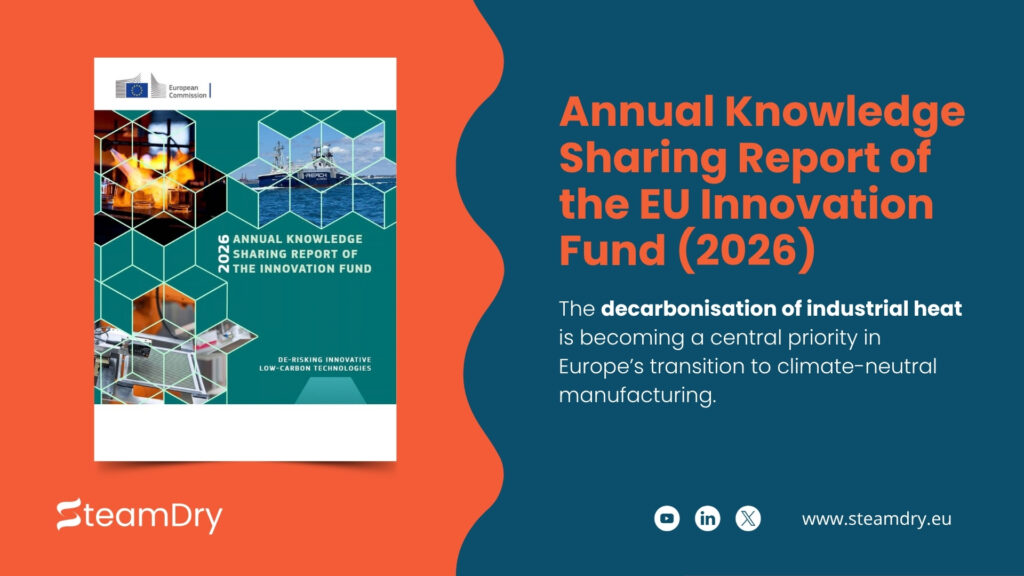
The decarbonisation of industrial heat is becoming a central priority in Europe’s transition to climate-neutral manufacturing. The latest Annual Knowledge Sharing Report of the EU Innovation Fund highlights how energy-intensive industries are advancing through a mix of electrification, renewable energy, energy storage, waste-heat recovery, fuel switching and process innovation.

For STEAMDRY, this is a particularly relevant development. Drying is an essential operation across many industrial value chains, yet it is often energy-intensive and reliant on fossil-based heat. Improving how this heat is generated, recovered, managed and used can therefore make a meaningful contribution to cutting industrial energy demand and greenhouse-gas emissions.

The message is clear: industrial heat is no longer a background issue. It is a strategic opportunity for competitiveness, resilience and decarbonisation.

From process heat to systemic change

The Innovation Fund report shows that energy-intensive industries are not following a single route towards decarbonisation. Instead, solutions are being tailored to the needs of different processes, sites and sectors.

For heat-intensive operations, the most relevant pathways include:

  • Electrifying processes where technically feasible and where renewable electricity is available.
  • Replacing fossil fuels with renewable or lower-carbon heat sources.
  • Recovering and reusing waste heat that would otherwise be lost.
  • Integrating thermal energy storage to improve flexibility and make better use of renewable energy.
  • Redesigning industrial processes to reduce energy demand while preserving product quality and productivity.

The report also underlines that thermal energy storage can help decarbonise heat supply, increase system flexibility and support the integration of renewable energy into heating networks and industrial processes. Examples in the Innovation Fund portfolio include solutions that store heat in solid materials, shift surplus renewable and waste heat over time, and recover heat from facilities such as data centres.

This is precisely the kind of systems perspective needed for industrial drying. The question is not only how much heat a dryer consumes, but also where that heat comes from, how efficiently it is used, whether it can be recovered and whether it can be matched with renewable-energy availability.

A timely opportunity for STEAMDRY

STEAMDRY is exploring pathways towards cleaner and more efficient industrial drying. In this context, the growing European focus on industrial heat creates an important opportunity to connect drying innovation with broader priorities:

  • Energy efficiency: reducing the energy required to achieve the same drying performance.
  • Renewable integration: enabling industrial processes to use renewable electricity and renewable heat more effectively.
  • Waste-heat valorisation: identifying opportunities to capture, upgrade and reuse heat within or across industrial sites.
  • Industrial flexibility: adapting heat demand to changing energy availability, prices and grid conditions.
  • Competitiveness: reducing exposure to volatile fossil-energy costs while supporting long-term industrial resilience.

The Innovation Fund report also recognises the practical barriers that innovative industrial projects face: high electricity costs, grid-connection constraints, evolving regulations, supply-chain challenges and the need to safeguard product quality during process changes. It points to early coordination with energy-system operators, long-term renewable-energy arrangements and strong value-chain partnerships as important enablers.

Making every unit of heat count

The industrial transition will depend not only on major investments in new infrastructure, but also on improvements to everyday processes. Drying may take place behind the scenes, but its energy footprint—and therefore its decarbonisation potential—can be significant.

STEAMDRY contributes to this broader shift by focusing attention on one essential question:

How can industrial drying deliver the required product quality while using energy more intelligently and producing fewer emissions?

As Europe accelerates the transition towards clean industrial heat, the answer will increasingly involve integrated solutions: efficient process design, renewable energy, heat recovery, thermal storage and digital optimisation working together.

For STEAMDRY, every step towards smarter drying is a step towards a more efficient, resilient and sustainable European industry.

Electrifying Europe’s Industry: How SteamDry Answers the 2025 State of the Energy Union Call

The 10th report on the State of the Energy Union confirms that the EU is on track towards its 2030 targets, with greenhouse‑gas emissions falling further and renewables already providing a rapidly growing share of electricity. At the same time, it stresses that reaching at least a 55% emissions reduction and a minimum 42.5% renewable share will only be possible with much faster clean‑tech deployment and stronger energy‑efficiency measures in buildings, heating, cooling and industrial processes.​

The report frames Europe’s strategic goal as becoming an “electro‑continent”, relying on domestically produced clean energy to cut fossil fuel imports, improve resilience and keep energy affordable. This implies a steep rise in electricity’s share of final energy use and a massive reduction in wasted energy across industry, especially in heat‑intensive steps such as drying.​

Why industrial drying is a hidden lever

More than 60% of the energy used by European industry goes into producing heat, and a large share of that is for low‑ to medium‑temperature applications such as drying, evaporation and pasteurisation. Studies show that roughly a third of Europe’s industrial process‑heat demand sits below 200 °C and is therefore technically suitable for electrification and high‑efficiency solutions like industrial heat pumps and advanced steam systems.​

In sectors such as pulp and paper, food and beverages and other web‑like products, conventional drying still relies heavily on combustion‑based systems and hot air, which inherently waste much of the supplied energy and lock in fossil fuel use. Cutting the energy need of these operations is therefore a powerful and often underestimated lever to reduce gas imports, lower costs and accelerate progress towards the Energy Union’s climate and competitiveness objectives.​

How SteamDry answers the Energy Union call

SteamDry focuses on advancing superheated steam drying technology for web‑like materials such as paper, board, tissue and nonwovens, using superheated steam instead of hot air as the drying medium. By circulating and reheating steam in a closed loop, SSD enables almost complete recovery of latent heat, significantly reducing net energy consumption while maintaining high product quality and hygiene.​

Analyses for the project indicate that, if deployed widely, SSD could unlock energy‑saving potential of around 127 TWh per year in European paper and board production and about 870 TWh globally. These savings directly support the report’s message that every additional percentage point of energy‑efficiency improvement translates into substantial reductions in fossil fuel imports and exposure to volatile gas prices.​

Aligned with the Affordable Energy Action Plan and Clean Industrial Deal

The State of the Energy Union underlines the implementation of the Affordable Energy Action Plan, which aims to reduce energy costs, modernise networks and strengthen interconnections while maintaining progress towards climate goals. SteamDry contributes to this agenda by offering industrial sites a technology that can lower energy bills, cut emissions and increase flexibility to use low‑carbon electricity and waste heat more effectively.​

The report also highlights the Clean Industrial Deal and the Competitiveness Compass as central tools for keeping European industry competitive during the transition by backing clean‑tech deployment and innovation. As a Horizon Europe project, SteamDry exemplifies how EU‑funded research and innovation can move from lab‑scale concepts to pilot‑scale demonstrations, creating investable solutions for equipment suppliers and manufacturers across the paper value chain.​

From policy signals to deployment decisions

For industrial stakeholders, the 10th State of the Energy Union is more than a policy snapshot; it is a strong signal that investments in efficient, electrification‑ready processes will be increasingly rewarded by regulation, funding instruments and market dynamics. Technologies that reduce dependence on imported fuels, lower exposure to carbon prices and stabilise operating costs are uniquely positioned to benefit from upcoming EU instruments and national support schemes.​

By demonstrating superheated steam drying at pilot scale and developing concepts for integration into existing and new industrial dryers, SteamDry helps de‑risk a key technology class that can turn the Energy Union’s high‑level objectives into real‑world energy and emissions savings. In doing so, the project contributes not only to EU climate and energy targets, but also to a more resilient, competitive and electrified European process industry.