
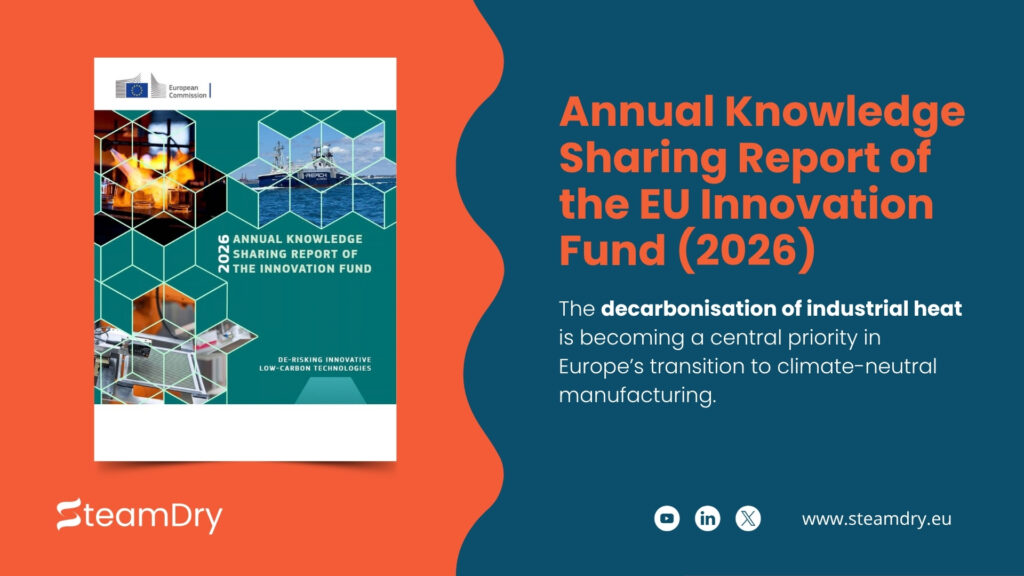
The decarbonisation of industrial heat is becoming a central priority in Europe’s transition to climate-neutral manufacturing. The latest Annual Knowledge Sharing Report of the EU Innovation Fund highlights how energy-intensive industries are advancing through a mix of electrification, renewable energy, energy storage, waste-heat recovery, fuel switching and process innovation.
For STEAMDRY, this is a particularly relevant development. Drying is an essential operation across many industrial value chains, yet it is often energy-intensive and reliant on fossil-based heat. Improving how this heat is generated, recovered, managed and used can therefore make a meaningful contribution to cutting industrial energy demand and greenhouse-gas emissions.
The message is clear: industrial heat is no longer a background issue. It is a strategic opportunity for competitiveness, resilience and decarbonisation.
From process heat to systemic change
The Innovation Fund report shows that energy-intensive industries are not following a single route towards decarbonisation. Instead, solutions are being tailored to the needs of different processes, sites and sectors.
For heat-intensive operations, the most relevant pathways include:
- Electrifying processes where technically feasible and where renewable electricity is available.
- Replacing fossil fuels with renewable or lower-carbon heat sources.
- Recovering and reusing waste heat that would otherwise be lost.
- Integrating thermal energy storage to improve flexibility and make better use of renewable energy.
- Redesigning industrial processes to reduce energy demand while preserving product quality and productivity.
The report also underlines that thermal energy storage can help decarbonise heat supply, increase system flexibility and support the integration of renewable energy into heating networks and industrial processes. Examples in the Innovation Fund portfolio include solutions that store heat in solid materials, shift surplus renewable and waste heat over time, and recover heat from facilities such as data centres.
This is precisely the kind of systems perspective needed for industrial drying. The question is not only how much heat a dryer consumes, but also where that heat comes from, how efficiently it is used, whether it can be recovered and whether it can be matched with renewable-energy availability.
A timely opportunity for STEAMDRY
STEAMDRY is exploring pathways towards cleaner and more efficient industrial drying. In this context, the growing European focus on industrial heat creates an important opportunity to connect drying innovation with broader priorities:
- Energy efficiency: reducing the energy required to achieve the same drying performance.
- Renewable integration: enabling industrial processes to use renewable electricity and renewable heat more effectively.
- Waste-heat valorisation: identifying opportunities to capture, upgrade and reuse heat within or across industrial sites.
- Industrial flexibility: adapting heat demand to changing energy availability, prices and grid conditions.
- Competitiveness: reducing exposure to volatile fossil-energy costs while supporting long-term industrial resilience.
The Innovation Fund report also recognises the practical barriers that innovative industrial projects face: high electricity costs, grid-connection constraints, evolving regulations, supply-chain challenges and the need to safeguard product quality during process changes. It points to early coordination with energy-system operators, long-term renewable-energy arrangements and strong value-chain partnerships as important enablers.
Making every unit of heat count
The industrial transition will depend not only on major investments in new infrastructure, but also on improvements to everyday processes. Drying may take place behind the scenes, but its energy footprint—and therefore its decarbonisation potential—can be significant.
STEAMDRY contributes to this broader shift by focusing attention on one essential question:
How can industrial drying deliver the required product quality while using energy more intelligently and producing fewer emissions?
As Europe accelerates the transition towards clean industrial heat, the answer will increasingly involve integrated solutions: efficient process design, renewable energy, heat recovery, thermal storage and digital optimisation working together.
For STEAMDRY, every step towards smarter drying is a step towards a more efficient, resilient and sustainable European industry.