
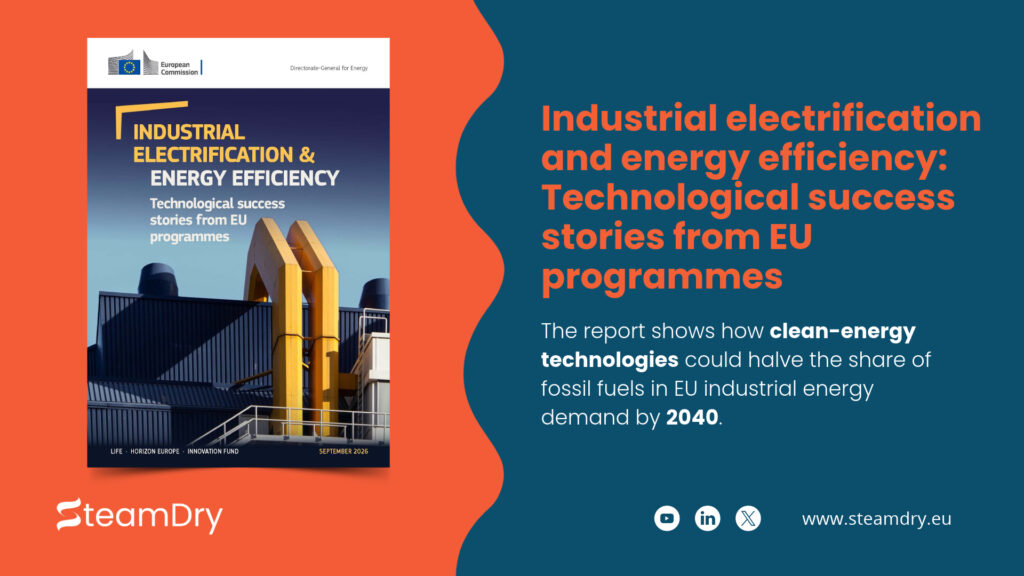
A new European Commission report shows how proven clean-energy technologies could halve the share of fossil fuels in EU industrial energy demand by 2040. Its findings reinforce the importance of solutions such as the superheated steam drying technology being developed by SteamDry.
Industry currently accounts for approximately one quarter of the EU’s final energy consumption, with fossil fuels still providing 49% of its energy. This dependence exposes European manufacturers to volatile fuel prices while affecting their competitiveness, energy security and decarbonisation efforts.
The European Commission’s new report, Industrial electrification and energy efficiency: Technological success stories from EU programmes, presents technologies tested through 189 demonstrators in 21 EU Member States. It reviews 85 EU-funded projects representing around €1 billion in investment, including approximately €600 million in EU support.
According to the report, deploying these technologies at scale could more than halve the proportion of fossil fuels in industrial energy consumption by 2040. Over the same period, industrial energy productivity—measured as value added per unit of energy consumed—could increase by approximately 32%.
Five technology families
The Commission groups the solutions into five complementary technology families:
- Industrial heat pumps and mechanical vapour recompression.
- Electric furnaces, boilers and kilns.
- Demand flexibility, local renewable energy and storage.
- Waste heat recovery and industrial symbiosis.
- Energy-efficiency upgrades involving motors, sensors, automation and digital optimisation.
Together, these technologies demonstrate that industrial electrification is no longer only a long-term ambition. Many solutions have already reached advanced technological readiness and can be replicated across European manufacturing sites.
Drying in the transition
Industrial drying is one of the areas with particularly significant potential. The Commission identifies drying among the low- and medium-temperature industrial processes for which mature electrification and energy-efficiency technologies are increasingly available. Relevant sectors include pulp and paper, food and beverages, chemicals, textiles and wood processing.
One of the success stories featured in the report is DryFiciency, an EU-funded project that demonstrated vapour-compression heat pumps at a brick-manufacturing plant and a starch-production facility. The 400 kW systems operated for more than 4,000 hours and supplied temperatures of up to 160°C. Compared with conventional gas burners, the demonstrators reduced final energy consumption by 66–81% and CO₂ emissions by 67–82%.
This example illustrates the wider opportunity presented by recovering heat that would otherwise be lost and returning it to the production process. The Commission estimates that industrial heat pumps can generate site-level savings of 30–50% in heat-related energy use when waste-heat sources and process demand are appropriately matched.
SteamDry’s contribution
SteamDry is advancing this transition by developing and piloting superheated steam drying for paper, board, tissue and other web-like materials. Instead of releasing moist exhaust air and its energy into the environment, the SteamDry concept circulates and reheats steam within a closed-loop system, enabling the recovery of most of the latent heat used during drying.
The project aims to reduce energy consumption in the drying process by more than 60%, equivalent to approximately 40% energy savings across an entire production line. It is also developing AI-supported monitoring and control systems to enable safe, efficient and scalable industrial operation.
In the longer term, the project estimates that applying this technology to European paper and board manufacturing could deliver annual energy savings of 127 TWh, with a potential value of around €6 billion. The technology is being designed for integration into both existing production infrastructure and newly built machines, supporting future industrial replication.
From demonstration to scale
The Commission report also makes clear that successful demonstrations are only the first step. Wider deployment will require better access to electricity grids, competitive electricity prices, investment support, faster permitting, standardisation and stronger demand for low-carbon industrial products.
For industrial drying, generating reliable operational evidence will be essential. Through its pilot activities, SteamDry is working to validate technical performance, energy savings, safe steam management, product quality and the potential for commercial scale-up. In doing so, the project contributes to the evidence base needed to move energy-efficient industrial drying from innovation to widespread adoption.
The Commission’s findings send a clear message: combining electrification, energy efficiency, waste-heat recovery and digital optimisation can reduce industrial costs and fossil-fuel dependence while strengthening European competitiveness. SteamDry is helping translate this ambition into a practical solution for some of Europe’s most energy-intensive manufacturing processes.
Read the European Commission’s overview and access the full report:
Industrial electrification – European Commission