Steamdry

EU report highlights industrial drying as a key opportunity for electrification and energy efficiency

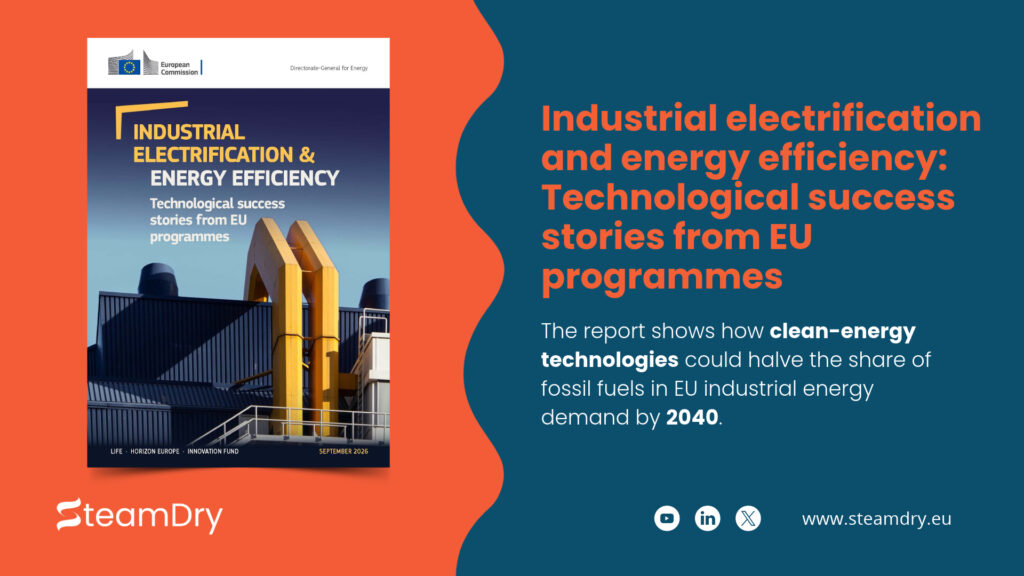
A new European Commission report shows how proven clean-energy technologies could halve the share of fossil fuels in EU industrial energy demand by 2040. Its findings reinforce the importance of solutions such as the superheated steam drying technology being developed by SteamDry.

Industry currently accounts for approximately one quarter of the EU’s final energy consumption, with fossil fuels still providing 49% of its energy. This dependence exposes European manufacturers to volatile fuel prices while affecting their competitiveness, energy security and decarbonisation efforts.

The European Commission’s new report, Industrial electrification and energy efficiency: Technological success stories from EU programmes, presents technologies tested through 189 demonstrators in 21 EU Member States. It reviews 85 EU-funded projects representing around €1 billion in investment, including approximately €600 million in EU support.

According to the report, deploying these technologies at scale could more than halve the proportion of fossil fuels in industrial energy consumption by 2040. Over the same period, industrial energy productivity—measured as value added per unit of energy consumed—could increase by approximately 32%.

Five technology families

The Commission groups the solutions into five complementary technology families:

  • Industrial heat pumps and mechanical vapour recompression.
  • Electric furnaces, boilers and kilns.
  • Demand flexibility, local renewable energy and storage.
  • Waste heat recovery and industrial symbiosis.
  • Energy-efficiency upgrades involving motors, sensors, automation and digital optimisation.

Together, these technologies demonstrate that industrial electrification is no longer only a long-term ambition. Many solutions have already reached advanced technological readiness and can be replicated across European manufacturing sites.

Drying in the transition

Industrial drying is one of the areas with particularly significant potential. The Commission identifies drying among the low- and medium-temperature industrial processes for which mature electrification and energy-efficiency technologies are increasingly available. Relevant sectors include pulp and paper, food and beverages, chemicals, textiles and wood processing.

One of the success stories featured in the report is DryFiciency, an EU-funded project that demonstrated vapour-compression heat pumps at a brick-manufacturing plant and a starch-production facility. The 400 kW systems operated for more than 4,000 hours and supplied temperatures of up to 160°C. Compared with conventional gas burners, the demonstrators reduced final energy consumption by 66–81% and CO₂ emissions by 67–82%.

This example illustrates the wider opportunity presented by recovering heat that would otherwise be lost and returning it to the production process. The Commission estimates that industrial heat pumps can generate site-level savings of 30–50% in heat-related energy use when waste-heat sources and process demand are appropriately matched.

SteamDry’s contribution

SteamDry is advancing this transition by developing and piloting superheated steam drying for paper, board, tissue and other web-like materials. Instead of releasing moist exhaust air and its energy into the environment, the SteamDry concept circulates and reheats steam within a closed-loop system, enabling the recovery of most of the latent heat used during drying.

The project aims to reduce energy consumption in the drying process by more than 60%, equivalent to approximately 40% energy savings across an entire production line. It is also developing AI-supported monitoring and control systems to enable safe, efficient and scalable industrial operation.

In the longer term, the project estimates that applying this technology to European paper and board manufacturing could deliver annual energy savings of 127 TWh, with a potential value of around €6 billion. The technology is being designed for integration into both existing production infrastructure and newly built machines, supporting future industrial replication.

From demonstration to scale

The Commission report also makes clear that successful demonstrations are only the first step. Wider deployment will require better access to electricity grids, competitive electricity prices, investment support, faster permitting, standardisation and stronger demand for low-carbon industrial products.

For industrial drying, generating reliable operational evidence will be essential. Through its pilot activities, SteamDry is working to validate technical performance, energy savings, safe steam management, product quality and the potential for commercial scale-up. In doing so, the project contributes to the evidence base needed to move energy-efficient industrial drying from innovation to widespread adoption.

The Commission’s findings send a clear message: combining electrification, energy efficiency, waste-heat recovery and digital optimisation can reduce industrial costs and fossil-fuel dependence while strengthening European competitiveness. SteamDry is helping translate this ambition into a practical solution for some of Europe’s most energy-intensive manufacturing processes.

Read the European Commission’s overview and access the full report:
Industrial electrification – European Commission

Industrial heat is moving up Europe’s decarbonisation agenda

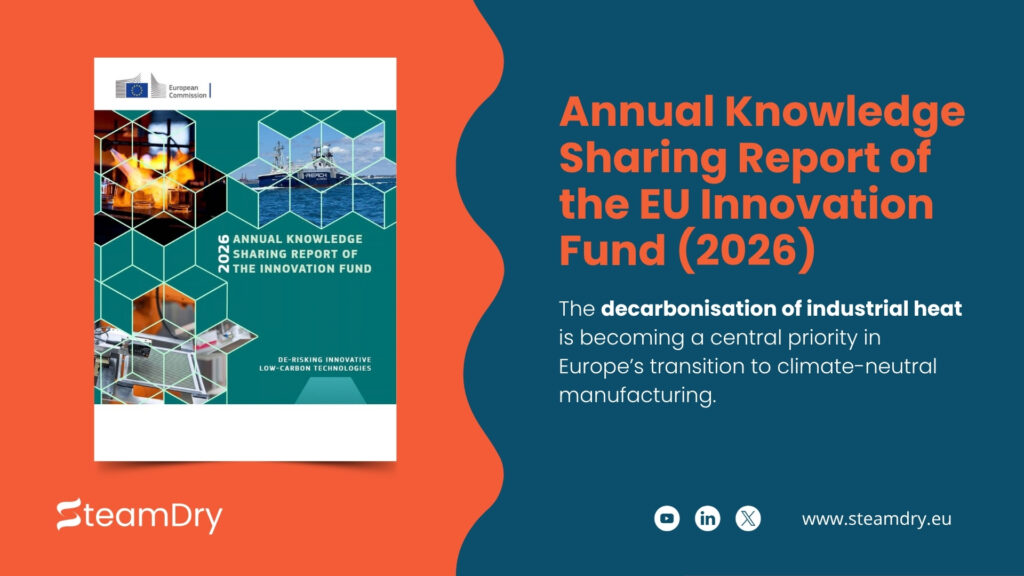
The decarbonisation of industrial heat is becoming a central priority in Europe’s transition to climate-neutral manufacturing. The latest Annual Knowledge Sharing Report of the EU Innovation Fund highlights how energy-intensive industries are advancing through a mix of electrification, renewable energy, energy storage, waste-heat recovery, fuel switching and process innovation.

For STEAMDRY, this is a particularly relevant development. Drying is an essential operation across many industrial value chains, yet it is often energy-intensive and reliant on fossil-based heat. Improving how this heat is generated, recovered, managed and used can therefore make a meaningful contribution to cutting industrial energy demand and greenhouse-gas emissions.

The message is clear: industrial heat is no longer a background issue. It is a strategic opportunity for competitiveness, resilience and decarbonisation.

From process heat to systemic change

The Innovation Fund report shows that energy-intensive industries are not following a single route towards decarbonisation. Instead, solutions are being tailored to the needs of different processes, sites and sectors.

For heat-intensive operations, the most relevant pathways include:

  • Electrifying processes where technically feasible and where renewable electricity is available.
  • Replacing fossil fuels with renewable or lower-carbon heat sources.
  • Recovering and reusing waste heat that would otherwise be lost.
  • Integrating thermal energy storage to improve flexibility and make better use of renewable energy.
  • Redesigning industrial processes to reduce energy demand while preserving product quality and productivity.

The report also underlines that thermal energy storage can help decarbonise heat supply, increase system flexibility and support the integration of renewable energy into heating networks and industrial processes. Examples in the Innovation Fund portfolio include solutions that store heat in solid materials, shift surplus renewable and waste heat over time, and recover heat from facilities such as data centres.

This is precisely the kind of systems perspective needed for industrial drying. The question is not only how much heat a dryer consumes, but also where that heat comes from, how efficiently it is used, whether it can be recovered and whether it can be matched with renewable-energy availability.

A timely opportunity for STEAMDRY

STEAMDRY is exploring pathways towards cleaner and more efficient industrial drying. In this context, the growing European focus on industrial heat creates an important opportunity to connect drying innovation with broader priorities:

  • Energy efficiency: reducing the energy required to achieve the same drying performance.
  • Renewable integration: enabling industrial processes to use renewable electricity and renewable heat more effectively.
  • Waste-heat valorisation: identifying opportunities to capture, upgrade and reuse heat within or across industrial sites.
  • Industrial flexibility: adapting heat demand to changing energy availability, prices and grid conditions.
  • Competitiveness: reducing exposure to volatile fossil-energy costs while supporting long-term industrial resilience.

The Innovation Fund report also recognises the practical barriers that innovative industrial projects face: high electricity costs, grid-connection constraints, evolving regulations, supply-chain challenges and the need to safeguard product quality during process changes. It points to early coordination with energy-system operators, long-term renewable-energy arrangements and strong value-chain partnerships as important enablers.

Making every unit of heat count

The industrial transition will depend not only on major investments in new infrastructure, but also on improvements to everyday processes. Drying may take place behind the scenes, but its energy footprint—and therefore its decarbonisation potential—can be significant.

STEAMDRY contributes to this broader shift by focusing attention on one essential question:

How can industrial drying deliver the required product quality while using energy more intelligently and producing fewer emissions?

As Europe accelerates the transition towards clean industrial heat, the answer will increasingly involve integrated solutions: efficient process design, renewable energy, heat recovery, thermal storage and digital optimisation working together.

For STEAMDRY, every step towards smarter drying is a step towards a more efficient, resilient and sustainable European industry.

From Pilots to Policy: How Europe Can Scale Electrified Industrial Heat

Highlights

  • Industrial electrification is now seen as essential for Europe’s energy independence, competitiveness and climate neutrality, not just a technical option.
  • Process heat remains a major source of emissions in sectors like paper, ceramics, asphalt and aluminium, but proven electrified solutions already exist and work in pilots.
  • The biggest barrier to deployment is economics: electricity is still significantly more expensive than gas in many Member States, and upfront investment costs are high.
  • Policymakers and industry agree on the need for a coherent framework that combines the European Green Deal, ETS, targeted auctions, national funding and carbon pricing to structurally lower the cost of clean heat.
  • Industry voices stress that trust, digital control and proof of product quality are just as important as technology performance to convince conservative sectors to switch.

Main conclusions

  1. Electrification is a strategic necessity, not a niche option

Opening the policy panel, MEP Nicolás González Casares framed industrial electrification as “an essential condition for the future of Europe,” linking it directly to energy sovereignty and the need to reduce exposure to volatile fossil fuel imports. He argued that the European Green Deal remains the key policy umbrella for industrial decarbonisation and warned that weakening its legislation would undermine progress on electrified heat.

Other panellists echoed this view: electrification is not only about cutting emissions, but about maintaining a competitive industrial base in Europe, where energy costs and climate policy are increasingly determining where companies invest and produce.

  1. The economics of energy are still the main bottleneck

Alper Akdag (A.SPIRE and ABB) highlighted that roughly half of industrial energy demand goes to process heating, yet only a small fraction of that heat is currently electrified. He underlined two major hurdles: relatively high electricity prices compared to gas in countries such as Germany, Belgium and Italy, and the significant capital expenditure required to convert existing fossil-based systems to electrified solutions.

Industry representatives, including Marcel Mallah (Fricke und Mallah Microwave Technology) and Katariina Torvinen (Valmet), confirmed that many customers will continue using gas as long as it is cheaper, even when microwave or other electric technologies deliver faster processes and lower energy use. For them, the price of electricity and the ability to stabilise business cases over the long term are decisive factors in investment decisions.

  1. Technology is ready at pilot level, but confidence and integration must follow

The panel built on earlier presentations from SteamDry and MetaWave showing that superheated steam drying and advanced microwave/plasma/induction heating can deliver substantial energy savings and CO₂ reductions in paper, ceramics, asphalt and aluminium. However, speakers stressed that moving from pilots to deployment is not only a matter of scaling equipment.

Marcel Mallah emphasised that microwave solutions require materials with suitable dielectric properties and that product quality must be validated through mechanical and physical testing, which demands time, money and dedicated research projects. Katariina Torvinen highlighted the need to integrate electrified components into whole‑mill concepts, supported by advanced digital control to manage variable renewable electricity and ensure stable operation.

  1. Policy tools must lower costs and de‑risk investment

When asked which policy or market change would most accelerate electrified industrial heat by 2030, panellists converged on three priorities:

  • Structural price signals: aligning taxation and carbon pricing so that electricity used for industrial heat is consistently cheaper than gas, including reforms to the Energy Taxation Directive and strong, predictable ETS rules that discourage fossil fuel use and fund clean alternatives.
  • Targeted funding and de‑risking: using instruments such as the Innovation Fund, industrial heat auctions, national recovery and resilience plans, and carbon contracts for difference (CfDs) to reduce CAPEX risk and support first‑of‑a‑kind projects.
  • Stable regulatory framework: providing long‑term certainty for companies planning multi‑decade investments, so business cases for electrified heat are not undermined by sudden policy reversals.

Nicolás González Casares stressed that ETS revenues should be used to support transformation and innovation, not short‑term bill relief, and defended a robust ETS as the backbone of Europe’s decarbonisation pathway.

  1. Scaling requires a systems approach: integration, flexibility and trust

The panel agreed that scaling electrified heat is about more than replacing burners with electric devices. It requires:

  • Integration with heat recovery, insulation and, where appropriate, hybrid systems combining different technologies.
  • New sensors, modelling and digital twins to maintain quality under harsh industrial conditions and coordinate production with renewable availability and market prices.
  • Virtual power plant and energy management concepts to align industrial demand with a cleaner, more flexible electricity system.
  • Clear safety standards, skills development and evidence of economic feasibility to build trust among conservative industrial sectors.

Overall, the policy panel sent a clear message: Europe already has working pilot solutions for electrified industrial heat; what is needed now is a coherent mix of policy, price signals and industrial partnerships that make clean heat the default, lowest‑cost choice for energy‑intensive industries in the coming decade.

Electrification and advanced heat for energy intensive industries: from pilots to EU wide deployment

18 June 2026 (09:30–11:00 CEST) – Online (Microsoft Teams)

REGISTER HERE
CHECK THE AGENDA

This joint Sustainable Energy Day by SteamDry and METAWAVE is organised in the framework of EU Sustainable Energy Week (EUSEW) 2026, the main annual event of the European Union dedicated to renewables and energy efficiency. EUSEW provides a platform to present innovative projects, exchange best practices and build partnerships that support the EU’s energy and climate goals, including higher energy‑efficiency targets, accelerated renewables deployment and climate‑neutrality by 2050.

By focusing on the electrification of industrial heat in sectors such as paper and board, ceramics, asphalt and aluminium, the event contributes directly to these objectives. Electrified process‑heat solutions like superheated steam drying and microwave‑based high‑temperature processes can significantly reduce fossil fuel use, lower greenhouse‑gas emissions and improve energy efficiency in some of Europe’s most energy‑intensive value chains. At the same time, they help implement key EU strategies such as the Green Deal, REPowerEU and the Industrial Green Deal, which all call for faster decarbonisation of industry while preserving competitiveness and quality jobs.

The session is designed not only to showcase technical progress, but also to inform policy. Through a combination of data‑driven presentations, project pitches and an interactive policy panel with representatives from EU‑level initiatives, industry and the European Parliament, the event will identify barriers and enablers for scaling up electrified heat. The resulting messages aim to support EU and national decision‑makers in designing regulations, funding instruments and industrial strategies that accelerate the transition of energy‑intensive industries in line with Europe’s climate and energy targets.

Programme highlights

Welcome and opening remarks (09:30)
Policy keynote: why industrial heat electrification now (09:35)
  • Alper Akdag – Chair of A.SPIRE Working Group 1 (Energy and CO₂), setting the scene on the EU policy context, REPowerEU and support for energy‑intensive industries.
The challenge: energy use and CO₂ in energy‑intensive process industries (09:45)

Data‑driven overview of current energy use, fuel mix and emissions in the processes targeted by SteamDry and METAWAVE, and the potential impact of electrified solutions.

Project pitches: electrification solutions in practice (10:00)
  • METAWAVE – Microwave‑based high‑temperature processes for energy‑intensive sectors.
    María Herrando – METAWAVE project coordinator and senior researcher at ITA Instituto Tecnológico de Aragón.

Concise, policy‑oriented presentations on the technologies, their main industrial applications and the practical challenges to large‑scale deployment.

Interactive policy panel: what industry needs to scale electrified heat (10:20)

Moderated discussion on policy changes, instruments and regional initiatives needed to accelerate the deployment of electrified process heat, including audience questions and a short live poll.


This Sustainable Energy Day aims to feed concrete messages from industry and research into the wider EUSEW policy debate on how to support the transition of energy‑intensive industries while maintaining competitiveness.